


Offshore wind turbines place flexible hoses in environments where saltwater, ultraviolet radiation, cyclic movement, and mechanical loads interact over long service periods. Hydraulic pitch systems inside turbine blades face repeated pressure cycles, while floating platforms introduce additional movement through waves and mooring dynamics.
These conditions are expanding the engineering scope of the reinforced hose extrusion line beyond conventional industrial hose production. DEKUMA is among the manufacturers developing extrusion solutions that can be adapted to changing application requirements, while offshore wind itself is driving more attention toward fatigue resistance and environmental durability.
Hydraulic Hoses for Pitch Control Systems
Blade pitch systems continuously adjust the angle of turbine blades to regulate aerodynamic forces and turbine operation. Hydraulic actuation requires hoses capable of transmitting pressurized fluid while accommodating movement around the hub and blade-root assembly. Every adjustment contributes another mechanical cycle, making long-term fatigue behaviour particularly important.
The hose does not experience pressure in isolation. Pressure pulses can occur alongside bending, twisting, vibration, and temperature variation. A construction that performs adequately during a static pressure test may still experience fatigue if repeated movement concentrates stress around fittings, bends, or reinforcement transitions.
Reinforcement provides structural support while retaining a degree of flexibility. Fibre type, braid or knit architecture, layer thickness, and placement can influence how a hose responds to pressure and movement. Offshore wind applications consequently require the mechanical construction to be considered together with the hydraulic duty cycle rather than assessed solely through nominal pressure ratings.
Floating Wind and Umbilical Hose Challenges
Floating offshore wind introduces another set of conditions because the platform itself moves with waves, wind, and currents. Flexible connections may need to accommodate repeated displacement over extended periods, particularly where equipment is connected between relatively mobile sections of the floating system.
Umbilical arrangements can contain hydraulic lines, electrical elements, communication components, or other service pathways within a protected assembly. The surrounding structure must accommodate bending without imposing excessive strain on individual hose layers. Bend radius, axial movement, torsion, and support spacing can consequently become important design variables.
Seawater exposure further changes the durability equation. External surfaces may face salt spray, immersion, marine organisms, and temperature fluctuations, while sunlight can contribute to polymer ageing on exposed sections. Material selection for the outer layer and reinforcement should reflect the actual installation environment rather than relying solely on properties measured under sheltered indoor conditions.
How Production Requirements Change Offshore
Offshore hose production places particular emphasis on consistency because small dimensional variations can influence mechanical behaviour across long lengths. During extrusion, stable material flow and controlled layer geometry contribute to predictable wall thickness. Reinforcement placement must also remain uniform so that pressure loads are distributed consistently around the hose circumference.
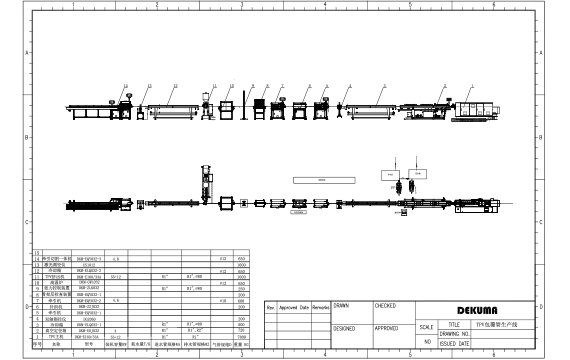
DEKUMA‘s TPV Knitted Reinforced Hose Extrusion Line uses a three-layer construction with a TPV inner layer, knitted polyester or aramid reinforcement, and a TPV outer coating. The configuration also supports double-layer and single-layer variants, providing an example of how multilayer equipment can accommodate different hose constructions. Such flexibility can be relevant when offshore applications require different combinations of flexibility, reinforcement, and environmental protection.
Process customization extends beyond the extrusion head. Material feeding, temperature management, reinforcement tension, haul-off speed, cooling, and dimensional inspection all influence the final hose structure. Offshore applications can place greater value on repeatability. Replacement or maintenance operations at sea may involve significantly more logistical effort than equivalent work on land.
Designing for Fatigue and Marine Exposure
Fatigue testing should reproduce the mechanical conditions that a hose is expected to experience in service. Hydraulic pitch hoses may require repeated pressure and bending cycles, while floating-wind connections may face combined bending and movement. Testing that isolates only one stress factor can overlook interactions between pressure, flexing, and environmental exposure.
Ultraviolet resistance is another consideration for externally exposed hoses. Solar radiation can alter polymer surfaces over time, particularly when exposure occurs alongside oxygen, heat, and moisture. Protective outer materials and appropriate stabilisation strategies can reduce the rate of environmental degradation, although the actual selection depends on the hose formulation and service conditions.
Seawater resistance also involves more than preventing visible corrosion. Chloride-rich environments can affect reinforcement materials, fittings, protective layers, and interfaces between different components. Qualification may consequently examine mechanical retention, ageing, pressure performance, and surface condition after prolonged environmental exposure rather than relying on a single seawater-resistance measurement.
Conclusion
Offshore wind places flexible hose systems in a service environment shaped by repeated movement and persistent exposure rather than by pressure alone. Hydraulic pitch control requires controlled flexibility and fatigue resistance, while floating platforms add larger-scale motion to the design equation. Marine conditions then bring ultraviolet radiation and seawater into the assessment.
DEKUMA’s multilayer extrusion approach illustrates how equipment can be configured around different hose structures, while a reinforced hose extrusion line and TPV extruder must ultimately reflect the specific fatigue, environmental, and pressure requirements of the offshore application.
