


Electric forklifts are becoming increasingly important in warehouses, manufacturing facilities, distribution centers, and logistics operations. Their productivity depends heavily on the battery because charging time, power delivery, operating duration, and maintenance can directly affect equipment availability. Selecting a suitable custom Li-ion battery can therefore help fleet operators align battery performance with demanding material-handling requirements.
For businesses evaluating electric forklift power systems, the right solution should be assessed beyond nominal capacity. Battery chemistry, module construction, current-carrying capability, thermal protection, charging strategy, and lifecycle monitoring can all influence how effectively a forklift performs during repeated industrial operations.
Why Battery Performance Matters in Electric Forklifts?
Forklifts experience changing power demands as they accelerate, stop, lift loads, and move across facilities. A suitable secondary battery cell and well-designed battery system should provide consistent power through repeated charging and discharging.
For fleet operators, battery efficiency can affect equipment utilization and downtime. However, performance depends on the forklift, workload, environment, charging infrastructure, and battery configuration, so evaluation should consider the complete system.
Dedicated Forklift Battery With 942Ah Capacity
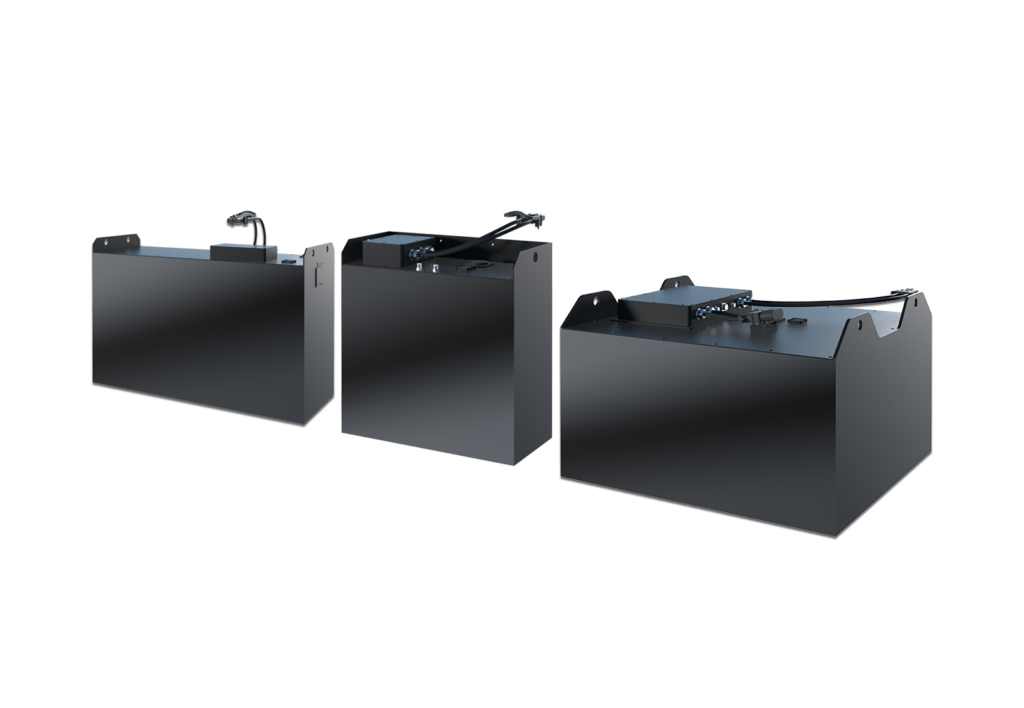
A major consideration is whether the battery architecture is specifically engineered for forklift applications. The company’s official power battery portfolio identifies a dedicated Forklift battery, rather than a generic battery pack, assembled using specialized engineering power cells. Its maximum configured capacity reaches up to 942Ah.
This specification gives fleet planners a concrete reference when assessing available energy. The appropriate capacity will still depend on the forklift’s voltage, load profile, operating hours, lifting frequency, and other equipment requirements. Capacity should therefore be matched to the actual duty cycle rather than selected independently.
Mechanical Construction for Industrial Operation
Material-handling equipment operates in environments where vibration and impacts can occur regularly. Battery modules therefore need a mechanical structure suitable for the conditions associated with forklift operation.
The dedicated Forklift battery uses metal end plates secured with stainless steel bands. Great Power states that this construction creates a stable and reliable module structure with strong resistance to vibration and impact.
This design consideration can help battery developers evaluate whether a particular system is appropriate for industrial vehicles rather than assuming that a battery designed for another application will provide the same mechanical suitability.
Thermal Protection Supports Battery Stability
Thermal behavior is another important factor in rechargeable battery operation. Repeated charging and discharging can generate heat, while excessive temperatures may affect battery performance and durability.
The Forklift battery incorporates insulating and heat-resistant materials inside its modules. The product information also states that the battery has passed thermal runaway propagation tests.
These features form part of the battery’s overall protection architecture. They should be considered together with appropriate charging controls, operating procedures, monitoring, and thermal conditions at the vehicle level.
LFP Chemistry for Forklift Battery Swapping
Battery chemistry also influences the characteristics of an electric vehicle power system. The company’s forklift battery swapping solution uses lithium iron phosphate, commonly called LFP, and integrates a proprietary Battery Management System for lifecycle monitoring.
The use of LFP provides a chemistry choice suited to applications where safety and repeated operation are important considerations. Nevertheless, fleet operators should evaluate the complete battery system rather than assuming that chemistry alone determines efficiency, safety, or service life.
1.5-Hour Charging Can Reduce Downtime
Charging availability can strongly influence forklift fleet utilization. According to the company’s published forklift battery swapping information, the solution can reach full charge in 1.5 hours, allowing forklifts to potentially be re-energized during a typical lunch break.
For operations with demanding schedules, faster charging can provide greater flexibility in planning vehicle availability. The actual charging time and workflow will depend on the specific battery, charger, vehicle, and site infrastructure, so project teams should verify compatibility before deployment.
Lifecycle Monitoring Adds Operational Visibility
Battery management is important when rechargeable batteries operate repeatedly in industrial environments. A BMS can monitor battery conditions and support protection and lifecycle management according to the system design.
The forklift battery swapping solution uses a proprietary BMS for full lifecycle monitoring. This can provide a useful foundation for managing battery operation over time and identifying conditions that require attention.
For businesses managing multiple electric forklifts, monitoring can also support more structured maintenance and battery-use planning when integrated with the wider vehicle and facility management strategy.
Why Battery Engineering Matters for Fleet Efficiency?
Battery efficiency is ultimately determined by the relationship between the cell, module, pack, vehicle, charger, and operating schedule. A high-capacity battery alone cannot guarantee improved productivity if charging infrastructure or vehicle requirements are poorly matched.
A secondary battery cell must therefore be evaluated according to its intended application. For forklift manufacturers and fleet operators, important factors include energy capacity, continuous current capability, thermal protection, mechanical durability, charging time, BMS functions, and compatibility with the vehicle.
This system-level approach can help businesses avoid selecting batteries based solely on headline specifications.
A Practical Power Solution for Electric Forklifts
Great Power’s dedicated Forklift battery provides application-specific specifications rather than relying on a generic battery description. Its maximum capacity of up to 942Ah, integrated busbar supporting up to 300A continuous charge and discharge per module, reinforced module construction, and thermal protection features give OEMs and fleet operators concrete parameters for technical evaluation.
The company’s broader battery business also serves multiple transportation and energy applications, while its published corporate information positions Great Power among the Global Top 500 New Energy Enterprises. According to the client information, its energy storage business additionally covers utility-scale, C&I, residential, portable, telecom base station, and smart solar-storage-charging applications.
For electric forklift manufacturers and fleet operators, choosing a custom Li-ion battery should ultimately be based on the vehicle’s real operating requirements. When capacity, current delivery, charging speed, mechanical design, thermal protection, and lifecycle monitoring are properly matched, a dedicated battery system can provide a stronger foundation for efficient and reliable material-handling operations.
